
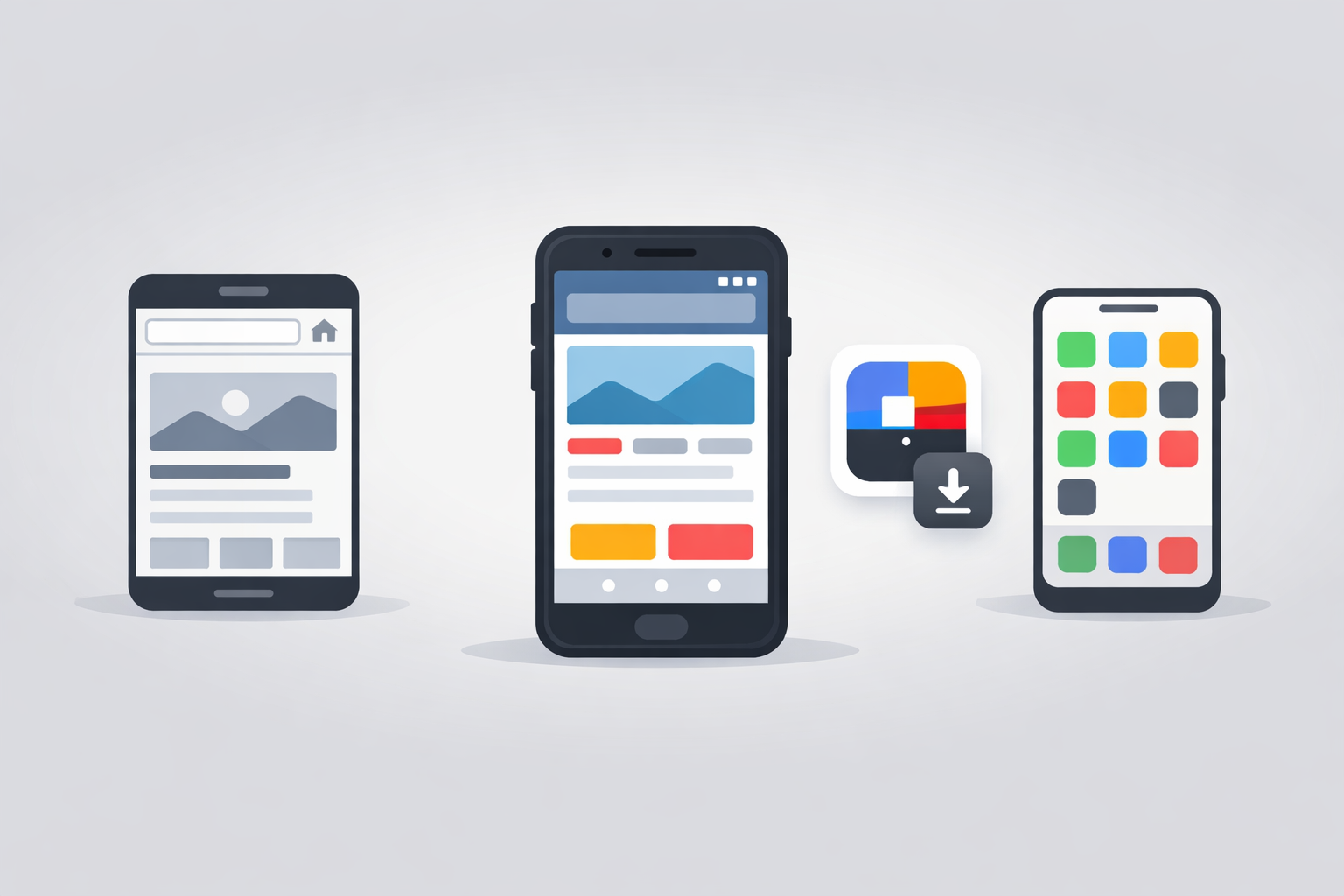
When a WordPress project starts to grow, the mobile question always comes up. Responsive website, PWA, native application: terms are often mixed, and the differences are not always clear.
This article focuses on the basics, without unnecessary jargon, to explain what each solution actually provides 🙂
The mobile website (responsive)
A mobile website is usually a responsive WordPress website. The same site adapts to the screen size, whether it is viewed on desktop, tablet or smartphone.
This is the simplest solution to implement. No store, no validation process, no mobile-specific maintenance.
- Accessible through a browser
- Single codebase to maintain
- Highly dependent on website performance
A well-optimized mobile website can be enough for many projects. Limitations usually appear in user experience and retention.
The Progressive Web App (PWA)
A PWA is still a website, but with additional features. It can be installed on the home screen, work partially offline and send notifications in some cases.
Technically, a PWA runs inside the browser. It is not a native application distributed through app stores.
- Installation without app stores
- Features depend on browser support
- Uneven support between iOS and Android
PWAs can look attractive on paper, but limitations appear quickly, especially on iOS.
The native application
A native application is distributed through the App Store and Google Play. It is installed like any other app on the device.
For WordPress-based apps, content is often displayed using a WebView, which is an embedded browser inside the application.
- Published on app stores
- Access to native device APIs
- Validation process imposed by Apple and Google
A native app offers better system integration, but also introduces additional constraints.
Which solution should be chosen?
There is no universal answer. It depends on the project, the budget and the goals.
- A simple website or blog: a mobile website is often enough
- A need for installation and notifications without stores: a PWA can be considered
- A strong mobile presence with an installed app: a native app is more consistent
The key point is understanding the constraints before choosing a technical solution 🙂