
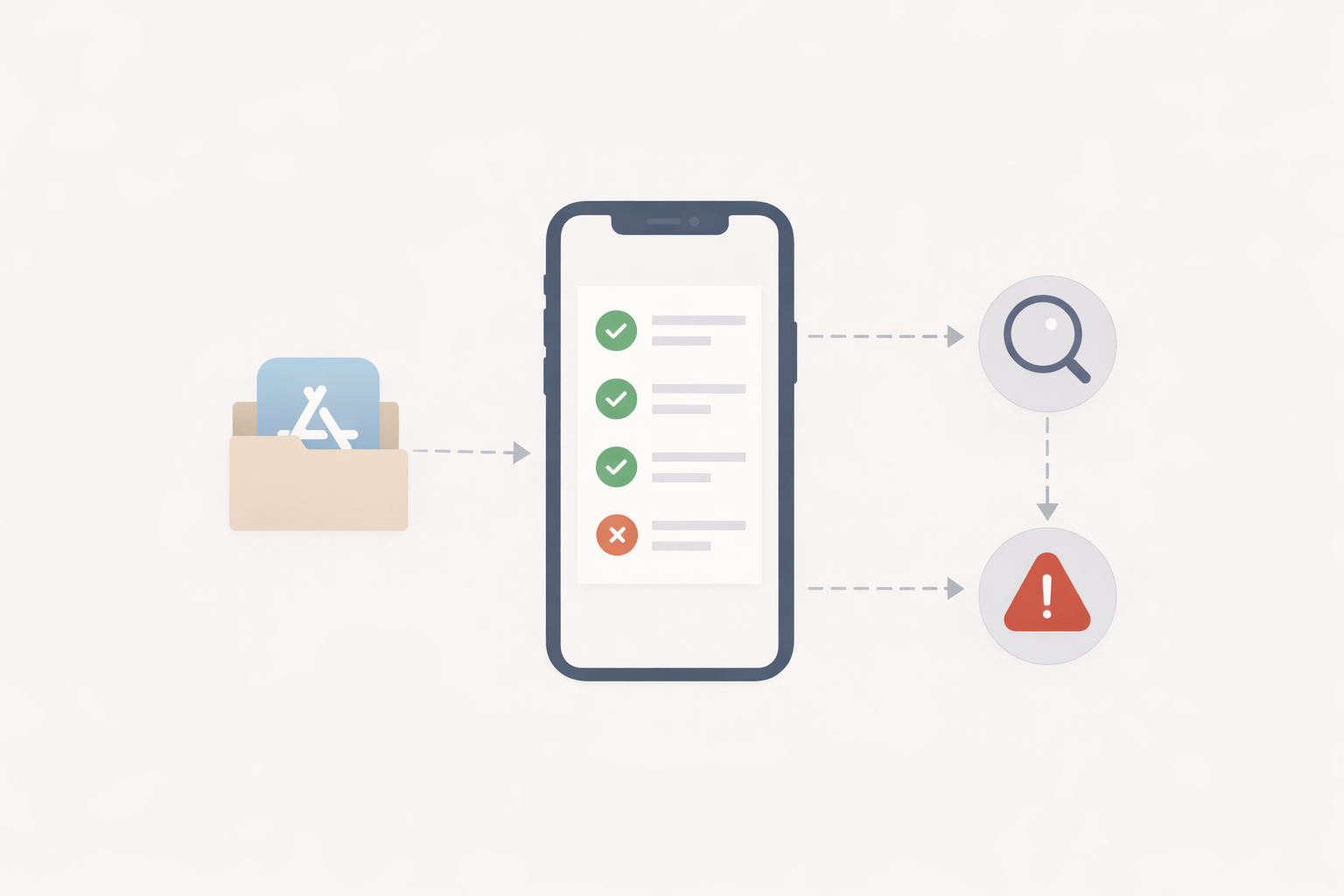
Publishing an app on the App Store is often seen as the final step of a project. In reality, it is a structural constraint that should be considered much earlier.
Apple does not simply check whether an app works. The platform enforces editorial, technical and economic rules that directly shape what makes sense to build.
The App Store review is not just a technical check
Every app goes through a human review. This means the evaluation includes interpretation and subjective judgment.
Beyond crashes or obvious bugs, Apple looks at real usefulness, user flow clarity and overall product coherence.
An app can therefore be rejected even if it is stable, simply because it does not meet Apple’s expectations in terms of experience or added value.
What Apple actually expects from an app
A common rejection reason is that the app feels like a simple website wrapped in an application.
For WebView-based apps, Apple expects clear reasons to install: smoother navigation, direct access to content, notifications, or a clear recurring use case.
This directly relates to the technical and functional limits of WebView apps discussed here:
what a WebView app can actually do.
Common rejections on simple projects
On WordPress or content-driven projects, rejections are rarely about complex bugs.
They usually involve lack of differentiation from the mobile website, confusing navigation or insufficient user value.
These decisions can be frustrating because they rely on qualitative criteria that are hard to anticipate without experience.
Why these rules should shape the design phase
Waiting until the end of development to think about App Store validation is a common mistake.
Apple’s framework should influence early decisions: app structure, feature scope and even whether publishing on the App Store makes sense.
Understanding these constraints early helps avoid costly iterations and forced compromises 🙂