
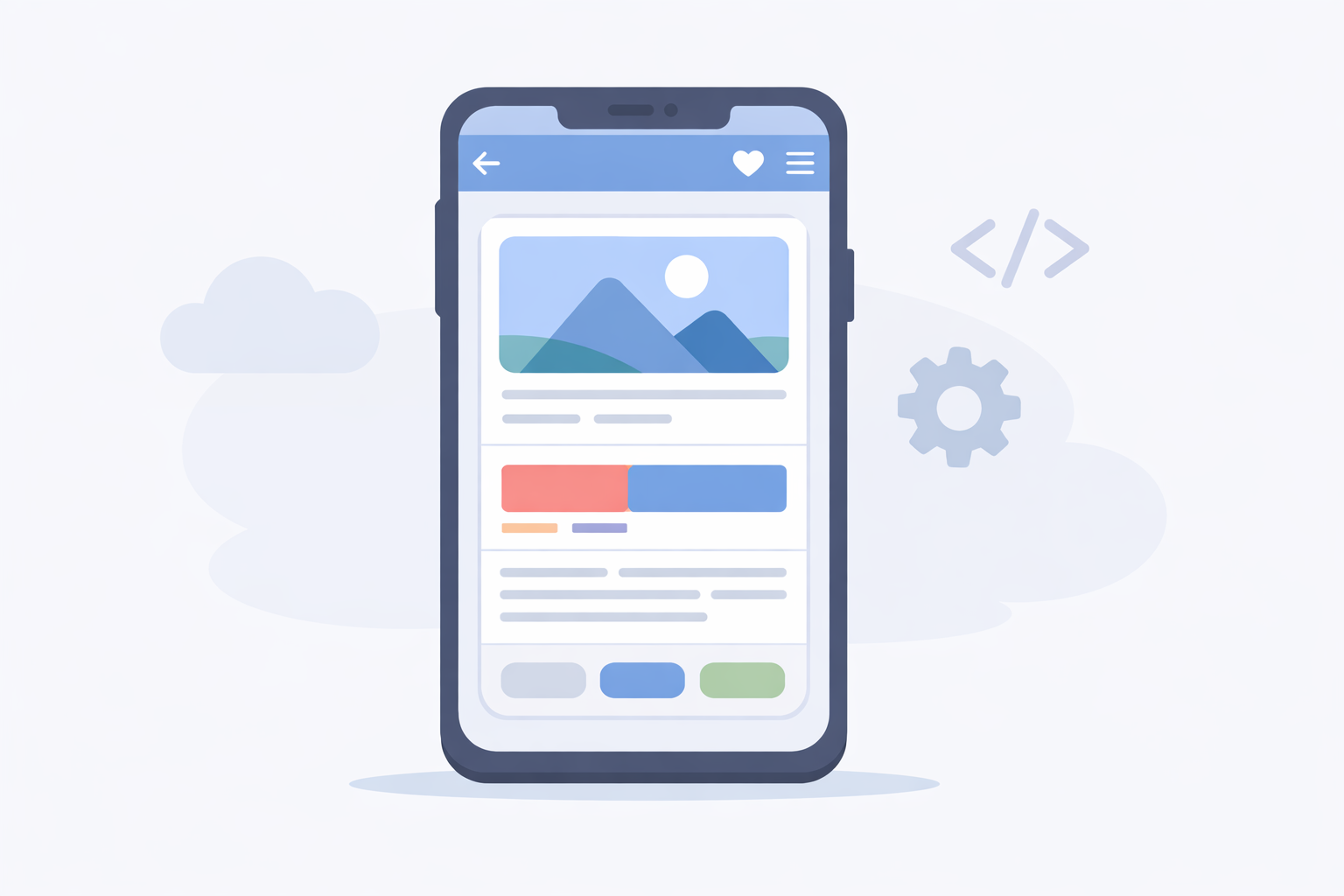
A webview mobile app is often presented as a middle ground between a website and a fully native application. The term, however, is rarely explained in plain language.
Before going further, it helps to understand the broader differences between a mobile website, a PWA, and a native app – covered in detail here: mobile website, PWA or native app.
What Is a WebView, Exactly?
A WebView is a native component provided by both iOS and Android. It lets a mobile application display web content without opening an external browser.
In practice, it acts as a built-in browser inside the app – with no address bar and no visible browser interface. The content is still HTML, CSS, and JavaScript, but it runs inside a native container.
On Android, this component is called Android System WebView. It is a pre-installed system service based on Chromium technology, updated independently from the OS. Many everyday apps – messaging clients, email apps, news readers – use it to display web pages without leaving the application. You can find the official reference in Google’s Android WebView documentation.
On iOS, the equivalent component is called WKWebView. It is built on Apple’s WebKit engine and is documented on Apple’s developer portal.
In short:
-
The displayed content is HTML/CSS/JS
-
Rendering relies on the system engine (Chromium on Android, WebKit on iOS)
-
The user has the impression of using a real app
-
No address bar is visible
A WebView App Is Not a Website
Even though the content is web-based, a webview app remains a fully native application in its own right.
It is distributed through Apple’s App Store or the Google Play Store. It installs like any other app, has a unique identifier, can access certain phone APIs, and must comply with the publication rules imposed by Apple and Google.
This is a point that is often misunderstood, especially when comparing a mobile app WebView to a PWA. A PWA is technically an enhanced website, accessible from a browser. A WebView app, on the other hand, goes through the stores and installs like a real application.
This distinction has practical consequences:
-
A WebView app appears in the stores and benefits from their discoverability
-
It can receive push notifications depending on the implementation
-
It is subject to store validation processes (timelines, rules, risk of rejection)
-
Users perceive it as an application, not a website
How WordPress Is Used Inside a WebView Mobile App
In most cases, WordPress acts as the content backend for a mobile app WebView.
Existing pages, posts, or features are loaded into the WebView without having to rewrite the entire business logic. The WordPress site remains the single source of truth: it is managed as before, and content updates appear immediately in the application.
This approach significantly reduces both cost and development time.
-
WordPress remains the familiar administration tool
-
The existing site is reused without a full redesign
-
Content updates are immediate, without going through the stores
-
No manual synchronisation is required
This is one of the main appeals of this solution for existing WordPress projects.
Advantages and Limits of a WebView App
A WebView app brings several concrete advantages:
-
Simpler and less expensive development than a fully native app
-
The website and the mobile application share the same codebase
-
Publication on the stores (App Store and Google Play)
-
Content updates without store submissions
-
Shorter time to production
But it also has limits worth knowing before committing:
-
Performance depends directly on the quality of the WordPress site
-
Access to native phone features is partial
-
Store constraints apply in full
-
User experience can suffer if the site is not optimised for mobile
For a thorough breakdown of what a WebView app can and cannot do, the dedicated article covers capabilities and limits in detail: WebView app capabilities and limits.
WebView App Security: What You Need to Know
Security is a topic rarely addressed in guides aimed at non-developers. Yet a few points are worth understanding, even without diving into code.
The JavaScript-to-native bridge
Some WebView apps use a mechanism called the JavaScript-to-native bridge. It allows the web layer of the application to communicate with native phone features: camera access, contacts, notifications, and so on.
This bridge is useful, but it introduces risk. If uncontrolled content is loaded into the WebView – an external page, an injected iframe – that content could theoretically interact with the exposed native features. This is what security specialists call a JavaScript-to-native bridge attack, documented by Google in its Android security recommendations.
In practice, this risk is most relevant when the application loads uncontrolled third-party content. For a WordPress app that only displays its own site, the risk is limited – but not zero.
The XSS risk
Cross-site scripting (XSS) is a vulnerability that allows an attacker to inject malicious JavaScript into a web page. In a WebView context, this risk is amplified when a native bridge is active: an injected script could then access the exposed native features.
The best practice is to load only content whose origin you control. For a WordPress site, this means keeping the site itself secure: plugins up to date, a maintained theme, and no unfiltered user-generated content displayed directly.
The importance of HTTPS
Loading content over HTTP (without encryption) in a WebView exposes the application to interception risks. An attacker on the same network could modify content in transit and inject malicious code.
The rule is straightforward: all content loaded in a WebView must go through HTTPS. For a WordPress site, this means an active SSL certificate and a systematic redirect from HTTP to HTTPS.
This is not specific to WebView apps – it is a general best practice for any website. But in the context of a mobile application, its importance is reinforced.
What this means in practice
For the vast majority of WordPress projects turned into a WebView app, these risks are manageable without advanced security expertise:
-
Ensure the WordPress site runs on HTTPS
-
Keep plugins and the theme up to date
-
Avoid loading uncontrolled third-party content in the app
-
Choose an app-building solution that handles these settings by default
WebView App vs Native App vs PWA: Comparison Table
Which solution should be chosen? There is no universal answer. Each approach addresses different needs.
|
Criterion |
WebView App |
Native App |
PWA |
|---|---|---|---|
|
Development cost |
Low |
High |
Low to medium |
|
Store presence |
Yes (App Store + Play) |
Yes |
No (with rare exceptions) |
|
Access to native APIs |
Partial |
Full |
Very limited (especially iOS) |
|
Performance |
Depends on the site |
Optimal |
Depends on the browser |
|
Content updates |
Immediate |
Store submission required |
Immediate |
|
User installation |
From the stores |
From the stores |
From the browser |
|
Maintenance |
Low (centralised site) |
High |
Low |
|
Time to production |
Short |
Long |
Very short |
This table is a summary. In practice, nuances vary considerably depending on the project, the target audience, and technical constraints.
For a deeper comparison between a WebView app and a PWA – particularly on deployment differences and constraints – the dedicated article explores both approaches in detail: WebView app or PWA: differences and limits.
When a WebView Mobile App Makes Sense
A webview mobile app is particularly well suited to existing WordPress projects that want a mobile presence without starting from scratch.
For small businesses, content creators, blogs, or small e-commerce sites, it is often a sound compromise between cost, maintenance, and user experience. The goal is not to compete with a bespoke native app, but to achieve store presence at a reasonable cost.
A few situations where this approach is relevant:
-
A WordPress site already well optimised for mobile
-
A need for store presence without a native development budget
-
Frequently updated content (articles, news, product catalogues)
-
A team with no dedicated mobile developer
Conversely, a WebView app is probably not the right fit if the project requires complex native features, a highly customised user experience, or high performance on heavy interactive content.
It is often a balanced compromise – neither the most powerful solution nor the most limited. Understanding its strengths and constraints makes it possible to make an informed choice from the start.