A mobile application is not reserved for large e-commerce brands. A small WordPress store can also benefit from offering an app, but probably not for the same reasons as Amazon or an international marketplace. Product volume, order count and company size are not the only criteria that matter.
For a WooCommerce store, the main question is the relationship with customers. An application becomes interesting when some buyers return, follow new products, browse the catalogue regularly or can benefit from notifications related to their orders. On the other hand, for a store where most customers make a single purchase after a Google search, the mobile website may be more than enough.
An app does not need to replace the WooCommerce store
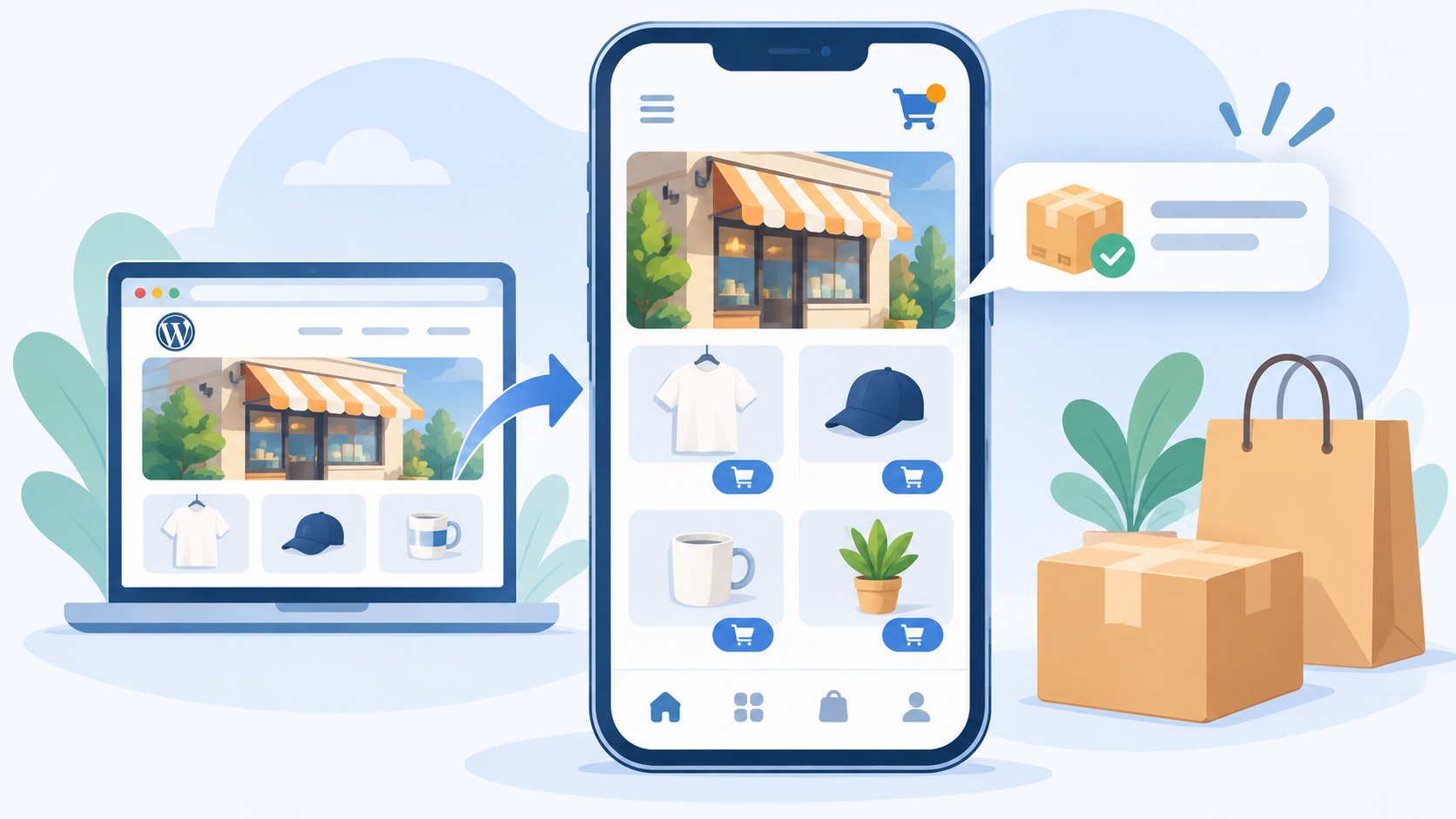
With a WebView app, WooCommerce continues to manage the catalogue, cart, customer accounts and orders. The application does not create a second store that needs to be synchronised. It displays the existing website in a native mobile environment and adds the functions required by the app.
This is particularly suitable for small e-commerce businesses because the project does not require two catalogues to be maintained. A new product added in WordPress appears in the app. A price change, an out-of-stock product or a new category follows the same principle.
I explain the operation and specific cases in more detail in the article about WPMobile and WooCommerce compatibility. The essential point is that WordPress remains the source of truth. The application is simply another way to access the same store.
Customer loyalty matters more than order volume
A small store can have relatively few orders while still having a very loyal customer base. This is often more interesting for an app than a website generating many one-off purchases.
A craft brand releasing new collections regularly, a specialist shop with an active community or a business whose customers reorder several times a year has a credible reason to remain on the home screen. Users already know the store and do not need to rediscover it for every visit.
On the other hand, if the product is purchased once every ten years, asking customers to install an application may simply add another step without creating value. Monthly visitor numbers are therefore not enough to decide. How often the same people return is usually much more informative.
Notifications are useful when they carry useful information
Push notifications can create a concrete difference between the website and the application. With WooCommerce, they can accompany transactional events such as new order information, notes, shipping, cancellations or other changes the customer is genuinely waiting for.
They can also be used editorially to announce a new collection or important information. That does not mean a small store should turn every promotion into a notification. An app that vibrates several times a week to announce another discount will quickly end up with notifications disabled.
The distinction between these uses is discussed in the article about editorial and transactional notifications. In an e-commerce context, finding the right balance is particularly important because the phone is a much more direct channel than an email newsletter.
The app does not remove the need for a good mobile website
A WooCommerce store that is slow or difficult to use on a smartphone will remain slow or difficult inside a WebView. The application does not fix a tiny add-to-cart button, an awkward variation selector or a checkout requiring fifteen fields.
Before publishing an app, it is therefore useful to complete an entire order on a phone: product page, variations if applicable, cart, login or account creation, address, shipping and payment. This is exactly the kind of journey that can be checked with the WPMobile test application before purchasing a licence.
This work is never wasted. The same improvements also benefit customers who continue ordering through Safari, Chrome or a desktop computer.
Payment deserves specific testing
WooCommerce checkout works inside the WebView, but not every payment method follows exactly the same journey. The most important case involves solutions that open a banking app or another external payment application.
Once payment has been approved, that external application generally has a web return URL. It may therefore reopen the website in the browser instead of returning to the WPMobile app. Payment and the WooCommerce order may have been completed correctly, but the end of the customer journey becomes less polished.
It is therefore worth testing the payment methods actually offered by the store. General WooCommerce compatibility cannot predict the behaviour of every banking application or external payment provider.
Physical products and digital content raise different questions
A shop selling clothes, handmade products, accessories or other physical goods is a conventional e-commerce use case. The rules become different when a purchase unlocks digital content, a feature or a subscription inside the app.
Apple and Google have specific rules for these digital purchases. WPMobile does not include an in-app purchase system. It should therefore not be assumed that everything that can be sold through WooCommerce on the Web can be offered in exactly the same way inside an application distributed through the stores.
The article about subscription apps and store rules covers this distinction in more detail. This is something worth checking before designing an app around a paid model.
A small store does not need to become Amazon
It is also important to keep the solution proportional to the requirement. A WebView app can be very relevant for a small WooCommerce store. It is not intended to provide the mobile architecture of an e-commerce giant with dedicated iOS and Android teams, fully custom interfaces and complex native processing.
That is precisely the benefit for a smaller organisation: reusing what already works. The catalogue stays in WooCommerce, administration stays in WordPress and the merchant does not have to learn a second platform just to edit a product.
The cost follows the same logic. WPMobile licences use a one-time payment model and do not depend on the number of products or orders. For a store with recurring mobile usage but neither the budget nor the need for custom development, the balance can be attractive.
The key question remains: why would a customer install the app?
The answer may be quick access to the store, order updates, notifications, a loyal community or simply a high purchase frequency. The answer may also be “no particular reason”. In that case, continuing to invest in the mobile website is probably the better choice.
A small store therefore does not need enormous traffic to justify an application. It mainly needs a group of customers for whom returning regularly makes sense. Those users, much more than the total visitor count, determine whether the app actually adds value.